Game guide
How to Play Hanafuda Koi-Koi: A Beginner's Guide
Learn the Japanese flower card game Koi-Koi step by step: the 48 cards, the 12 months, how matching works, the main scoring sets and when to call Koi-Koi.
Hanafuda, which means "flower cards," is a traditional Japanese card game played with a small, stiff deck decorated with plants and animals. Hanafuda decks have been made in Japan for well over a century; in fact, Nintendo started out in 1889 as a company that made hanafuda cards. The most popular game you can play with them is called Koi-Koi, a two-player game of matching and timing. You can play it against the computer in our free version of Hanafuda Koi-Koi.
The rules look strange at first because the cards have no numbers printed on them. Once you know how the deck is organized, though, Koi-Koi becomes a quick and surprisingly tense game. This guide covers everything you need for your first match.
The deck: 12 months, 4 cards each
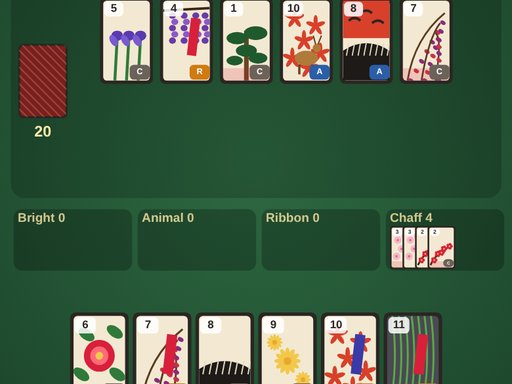
A hanafuda deck has 48 cards. There are 12 suits, one for each month of the year, and each suit has 4 cards showing the same plant. January is pine, February is plum blossom, March is cherry blossom, and so on through December, which is paulownia. In our game the month number is shown in the corner of every card, which makes learning much easier.
| Month | Plant | Month | Plant |
|---|---|---|---|
| 1 | Pine | 7 | Bush clover |
| 2 | Plum blossom | 8 | Pampas grass |
| 3 | Cherry blossom | 9 | Chrysanthemum |
| 4 | Wisteria | 10 | Maple |
| 5 | Iris | 11 | Willow |
| 6 | Peony | 12 | Paulownia |
Within each month, the cards have different values. They fall into four types:
- Brights (5 cards): the most valuable, such as the crane with the sun in January and the full moon over pampas grass in August.
- Animals (9 cards): cards with a creature or object, like the deer in October or the butterflies in June.
- Ribbons (10 cards): cards with a paper poetry strip. Some ribbons are red with writing, some are blue.
- Chaff (24 cards): plain plant cards, worth the least on their own but useful in bulk.
How a turn works
At the start of a round, each player gets 8 cards in hand and 8 cards are placed face up in the middle as the field. The rest form a face-down draw pile. On your turn you do two things:
- Play a card from your hand. If a field card shows the same month, you capture both cards and put them in front of you. If nothing matches, your card stays on the field.
- Flip the top card of the draw pile and do the same thing with it: capture a matching field card, or leave it on the field.
If two field cards match the card you play, you choose which one to take. If all three remaining cards of that month are on the field, you take all of them at once.
Scoring sets (yaku)
You do not score points for each card. Instead, you score by collecting certain combinations, called yaku. Here are the ones to learn first, using the point values from our game:
- Three Brights: three Brights, not counting the rain man card of November. 5 points. Four or five Brights score more.
- Boar, Deer and Butterfly: the three animal cards from July, October and June. 5 points, plus 1 for each extra animal.
- Red Poetry Ribbons: the three red ribbons with writing from January, February and March. 5 points, plus 1 for each extra ribbon.
- Blue Ribbons: the three blue ribbons from June, September and October. 5 points, plus 1 for each extra ribbon.
- Viewing the Blossoms / Viewing the Moon: the sake cup card together with the cherry blossom curtain, or with the full moon. 5 points each.
- Animals, Ribbons, Chaff: 5 animals, 5 ribbons or 10 chaff cards each score 1 point, plus 1 for every extra card.
You can open the Yaku list button during a game at any time to check every set and its points.
The big decision: Koi-Koi or stop?
As soon as you complete a scoring set, the game asks you a question. You can stop, which ends the round and gives you your points right away. Or you can call "Koi-Koi", which roughly means "come on," and keep playing to build an even bigger score.
The catch is that if you call Koi-Koi and your opponent completes a set before you score again, they can stop and win the round instead, and in our game their points are doubled. So Koi-Koi is a bet: you are betting that you will score again before your opponent does. This one decision is what makes the game exciting.
A good rule for beginners: stop early when you have a small score and the opponent has captured several Brights or two-thirds of a set. Call Koi-Koi when you only need one more card for a second set, and the card you need has not been played yet. Also note that in our version, a round total of 7 points or more is doubled, which makes pushing a 5-point hand to 7 very tempting.
Beginner strategy tips
- Watch the valuable cards. If a Bright or a key animal is on the field and you hold a card of the same month, take it before your opponent does.
- Deny, not just collect. Sometimes the best play is capturing a card your opponent obviously needs, even if it does not help you much.
- Count the months. Each month has only four cards. If three cards of a month have been played, the last one is either in someone's hand or in the draw pile.
- Do not dump valuable cards. If you have no match, play a chaff card rather than leaving a Bright on the field for your opponent.
Ready to try?
Our Hanafuda Koi-Koi game plays three rounds against the computer and keeps your best total score on your device. A full match takes about ten minutes, which makes it a good fit for a lunch break or the longer break in a study session. If you enjoy it, you might also like our other games inspired by Japan, described in Learn About Japan Through Our Original Games.