Learning
Math Puzzle Games That Make Practice Feel Like Play
How our own puzzle games sneak in real math thinking, from switching puzzles and sudoku to fractions you can cut, with tips for each.
Math practice has a reputation for being dull, but some of the most popular puzzle games are math in disguise. Merging numbers, balancing equations and spotting patterns all use the same skills you need in class. The difference is that a game gives you instant feedback and a reason to try one more time.
This guide covers the math-flavored games we built for Five Min Games, what skill each one practices, and how to get better at them.
Lantern Lights: the math of switching
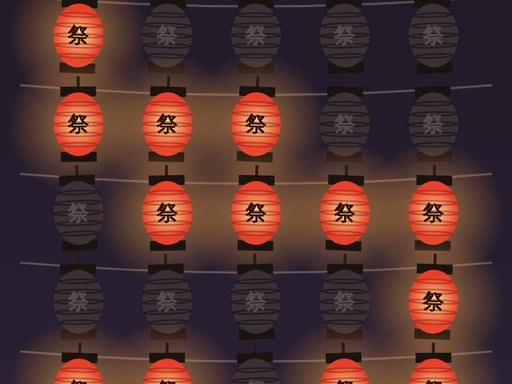
In Lantern Lights, tapping a paper lantern switches it and its neighbors above, below, left and right. The goal is to light every lantern. It looks like a reflex game, but it is pure logic, and it hides two neat math facts.
First, order does not matter. Tapping lantern A and then lantern B gives exactly the same board as tapping B and then A. Second, tapping the same lantern twice undoes itself, so a solution never needs a lantern tapped more than once. Put together, that means every puzzle comes down to one question: which set of lanterns do you tap? Mathematicians solve this kind of puzzle with linear algebra, using arithmetic where 1 + 1 = 0, because two switches cancel out.
Tip: work row by row. Light the top row by tapping lanterns in the row below it, then fix the second row from the third, and so on. If the bottom row is left wrong, the pattern there tells you which top-row lanterns to tap before you start again.
Paper Seasons: the same idea on a pop-up book
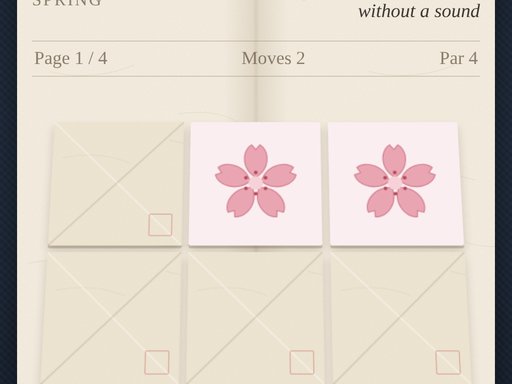
Paper Seasons uses the same flipping rule with washi paper tiles that turn from one season to the next. Because the rule is the same, the same row-by-row method works, which is a nice lesson in itself: once you understand the structure of a problem, you can reuse the method on a new-looking one.
Sudoku: pure logic with numbers
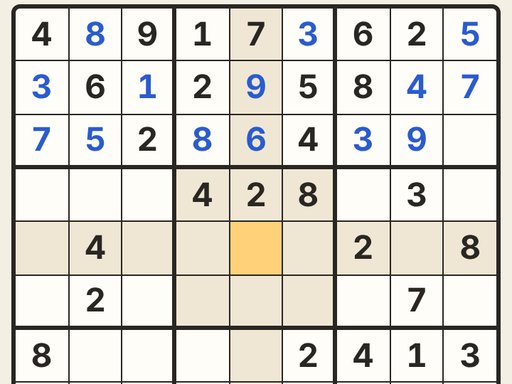
Despite the numbers, Sudoku needs no arithmetic at all. You fill a 9x9 grid so that every row, column and 3x3 box contains 1 to 9 once. The puzzle was first published in the United States in 1979 as "Number Place" and got its famous name in Japan, from a phrase meaning "the numbers must be single." It practices careful elimination: ruling out what cannot go somewhere until only one option is left.
Tip: scan for a box, row or column that is almost full, and look for a number that can go in only one square of a box. Use notes on harder puzzles so you do not have to keep every possibility in your head.
Nonograms: logic that draws a picture
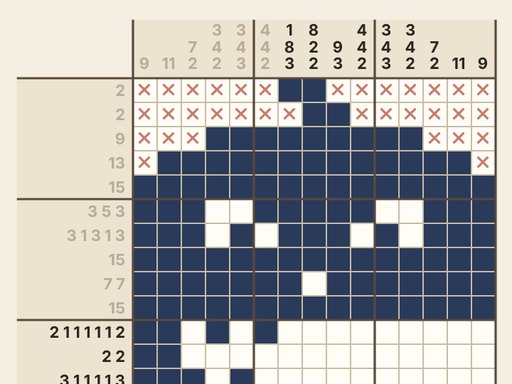
In a Nonogram, numbers beside each row and above each column tell you how many squares to fill, and in what groups. Fill the right squares and a picture appears. Nonograms were invented in Japan in the late 1980s and are also called picture logic puzzles or Picross. Like Sudoku, they need no arithmetic, but they do reward careful counting: in a row of 10 squares with a clue of 8, the middle 6 squares must be filled no matter where the group starts.
Tip: work back and forth between rows and columns. Every square you fill or mark with an X gives you new information for the line that crosses it.
Cutting games: fractions you can see
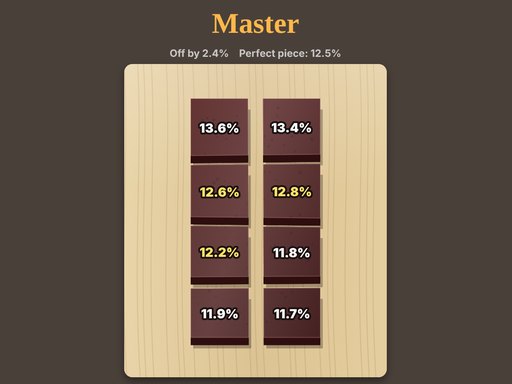
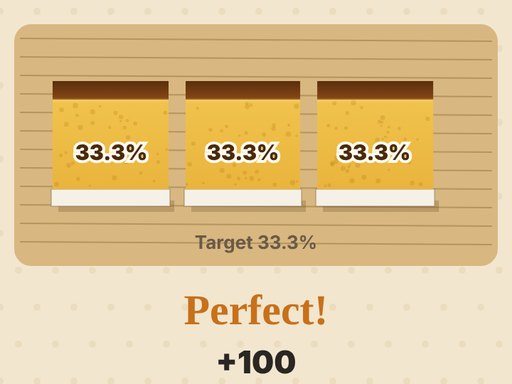
Fractions are easier to understand when you can see them. In our Yokan Cut, you slice a block of yokan, a Japanese red bean sweet, into equal pieces with straight swipes. When you finish, every piece shows its share of the whole as a percentage. For eight pieces the perfect share is 12.5%, which is the decimal form of 1/8. In Castella Slicer, customers ask for orders like "three equal pieces" or "exactly 2/5 from the left end", so you have to picture the fraction on the cake before you cut.
Tip: to cut eighths, halve, halve and halve again. Each halving is much easier to judge by eye than cutting one eighth directly, which is also why 1/8 = 1/2 x 1/2 x 1/2.
Logic puzzles that build math thinking
Not every useful game has numbers on the screen. Many logic puzzles practice the reasoning behind math: making a plan, testing it, and backing up when it fails.
- Bus Jam Puzzle: drive buses out of a jammed lot in the right order. Every move changes what is possible next, so it trains thinking several steps ahead.
- Origami Fold: fold one sheet into a model with a limited number of folds. Each fold is a reflection, so it quietly practices symmetry and spatial reasoning.
- Train Tracks: rotate track tiles until a path connects. It trains you to see how parts fit into a whole.
- Roll to the Bowl: draw a bamboo ramp to roll a ball into a tea bowl. Short, steep ramps behave very differently from long, gentle ones, which is a first taste of slopes and angles.
Using games as real practice
A game will not replace homework, but it can help in two ways. First, as a warm-up: a few rounds of Castella Slicer before a fractions worksheet gets your brain into number mode. Second, as review: if you just learned a rule in class, a game that uses it over and over helps it stick.
Keep it short, though. The point of a break is to rest. If you notice you are getting frustrated, switch to something calm, like the slow-paced puzzles in our guide to the best games for a five-minute break.