Learning
Learn the 50 States with a Map Puzzle
Practical ways to memorize the US states and capitals using a map puzzle, from starting with landmark shapes to learning regions, plus fun facts about state borders.
Knowing where the 50 states are is useful in history, government and science classes, and for understanding the news. Memorizing a list is slow, but putting a map together with your own hands works much faster. This guide explains how to use our US States Puzzle to learn the map, and shares a few facts that make the states easier to remember.
How the US States Puzzle works
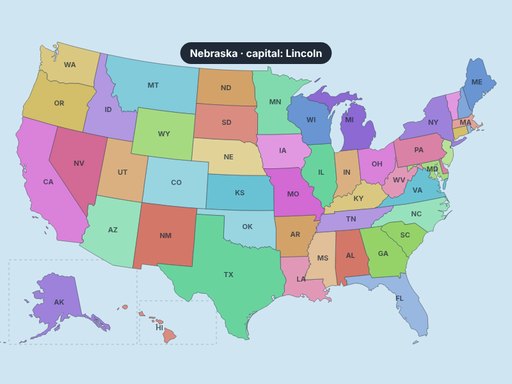
US States Puzzle has two modes. In Puzzle mode, you drag each state from the tray onto its place on the map, and it snaps in when you are close. Each time you place a state, the game shows its capital. In Find It mode, the game names a state and you click it on the map. Your score counts how many states you found on the first try.
Start with the landmark shapes
A few states have shapes almost everyone recognizes: Texas, California, Florida, Michigan's mitten, Louisiana's boot and the tall rectangle of Nevada next to California. Place those first. They act like the corner pieces of a jigsaw puzzle, and each one tells you where its neighbors must go.
Learn the map by region
Instead of 50 separate facts, think in groups:
- The Pacific coast: Washington, Oregon and California, stacked from north to south, plus Alaska and Hawaii.
- The Four Corners: Arizona, New Mexico, Colorado and Utah meet at a single point, the only place in the country where four states touch.
- The Great Plains: North Dakota, South Dakota, Nebraska, Kansas and Oklahoma form a column down the middle of the map.
- New England: Maine, New Hampshire, Vermont, Massachusetts, Rhode Island and Connecticut, the small states in the far northeast.
Once you know the regions, the remaining states fill in the gaps between them.
Tricky pairs to watch
Some states are easy to mix up. Vermont and New Hampshire are mirror images of each other: Vermont is wider at the top, New Hampshire is wider at the bottom. Iowa sits directly north of Missouri. Alabama is to the east of Mississippi, and Georgia is to the east of Alabama. Saying these pairs out loud while you place them helps them stick.
Capitals are not always the biggest city
Many state capitals are smaller than the state's best-known city. The capital of New York is Albany, not New York City; California's is Sacramento, not Los Angeles; and Illinois's is Springfield, not Chicago. In Puzzle mode, read the capital that appears after each state. Linking a capital to a shape you just placed is much easier than memorizing a list.
Practice in short rounds
A full puzzle takes about five to ten minutes, which makes it a good study break. Try to beat your best time in Puzzle mode, then switch to Find It and aim for a higher first-try score. Short, repeated rounds over several days work better than one long session. For more learning games, see our guides to math puzzle games and word games for vocabulary.